.jpg)
Condominio Monte Amiata
An Architectural Icon in the Heart of Gallaratese
A Living Monument
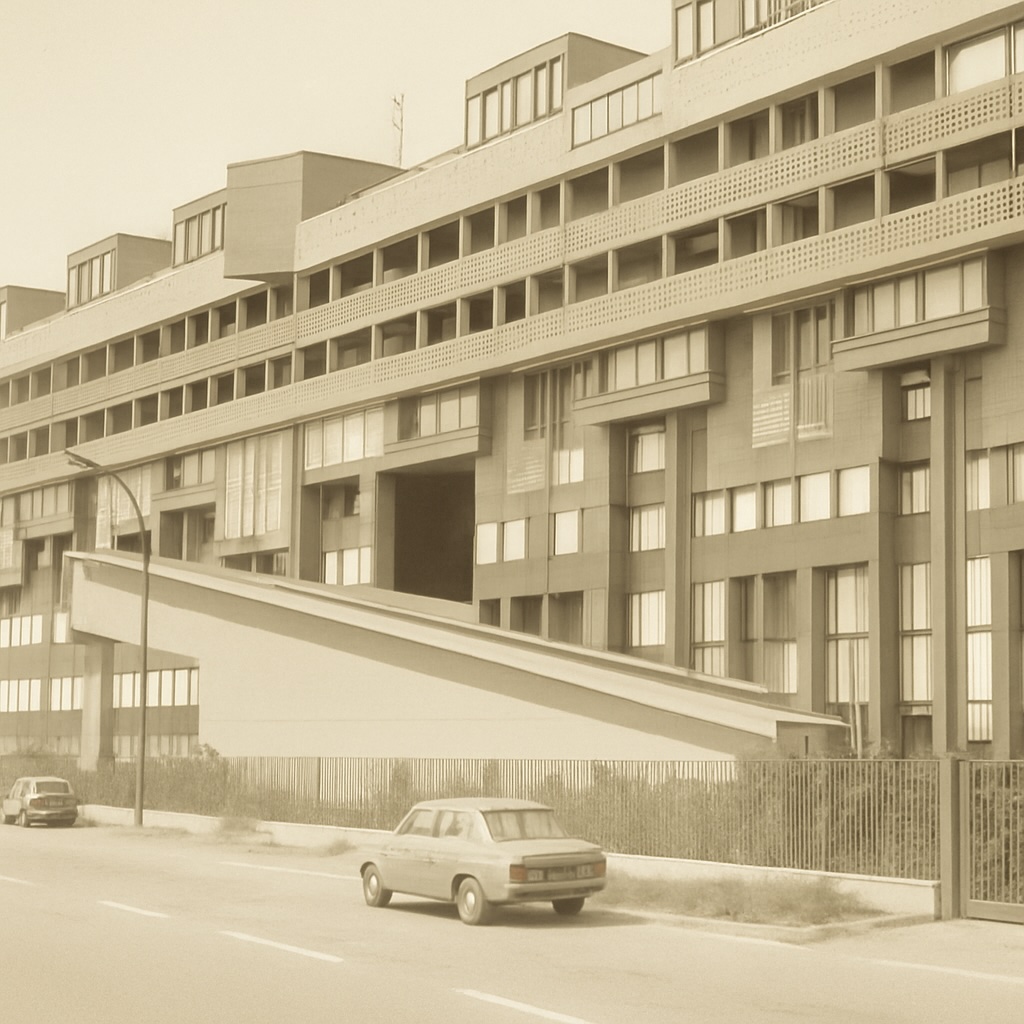
Designed by architects Carlo Aymonino and Aldo Rossi between 1967 and 1974, the Monte Amiata complex is a landmark of postmodern architecture, a place where you can find bold geometry, rich history and innovative ideas about community living—all in one iconic destination. This distinctive residential compound is a milestone of Italian neo-rationalist architecture and a must-see for contemporary design and heritage enthusiasts.
This digital space is dedicated to its history, its community, and its enduring legacy.
Story
- Timeline: 1944 land acquisition by Società Mineraria Monte Amiata; late-1960s commission; 1967 start; 1974 completion.
- Discussion of social housing context in post-war Milan; intent to build for approx. 2,400 residents.
- Description of site area (120,912 m²) and block arrangement: five buildings, central amphitheatre, triangular plazas.
- Introduction to Carlo Aymonino (1926-2010) and Aldo Rossi (1931-1997).
- The collaboration: Aymonino invited Rossi in 1968 to design part of the project.
- Contrasting visions: Aymonino’s “fragmentism” (city as turbulent, varied texture) vs Rossi’s clear, uniform slab building.
- The architectural significance: the intent of creating not just housing but a community, and their role in Italian architecture.
Curiosities
- It’s nicknamed the “Red Dinosaur” (rosso)
- Interesting architectural corridors, elevated walkways, bridges, varied volumes - where you can get lost or at least tele-transported into another dimension
- Film/photography references (e.g., used as a location).
- Trivia: It took the inspiration from Unité d’Habitation by Le Corbusier, and had the aim to improve on the model.